

News
May 15th 2026 – Sabrina St-Georges receives a FRQ funding grant
Congratulations to Sabrina St-Georges whose master's project received a grant from the Fonds de recherche du Québec!
The project consists of assessing the impact of agricultural activities on the carbon stocks of peatlands in southern Quebec. This project is part of the project of quantification and cartography of carbon reserves stored in wetlands of southern Québec

May 14th 2026 – Launch of the CARCLIQUE Chair
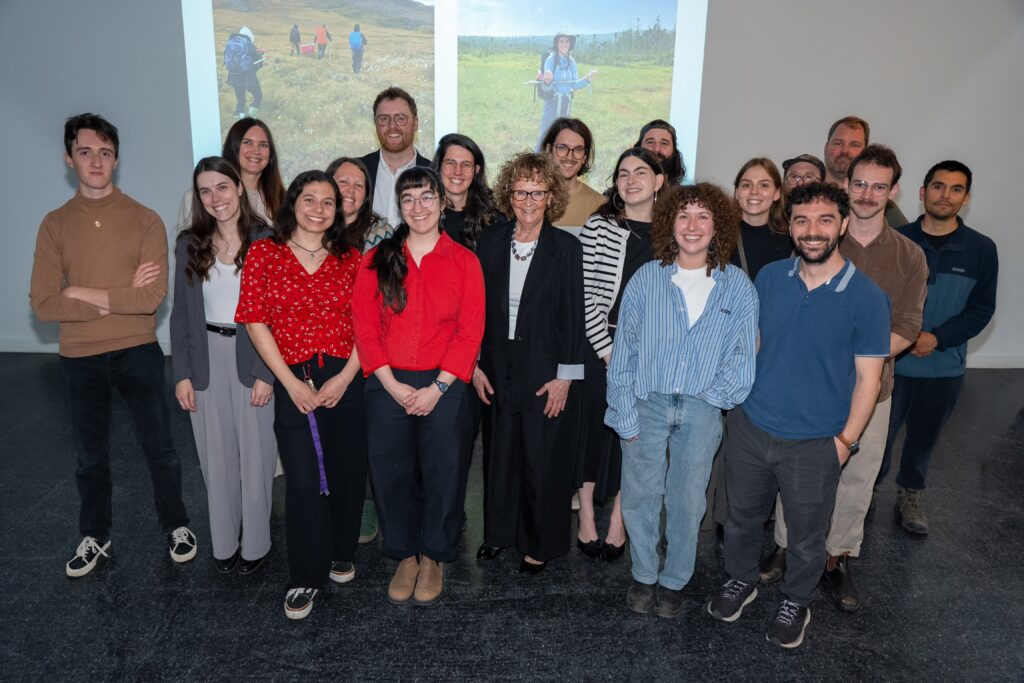
On May 14, 2026 at the Coeur des sciences of UQAM took place the launch of the Chair CARCLIQUE dedicated to the study of carbon in wetlands as a nature-based solution to combat climate change. This research chair is co-directed by Michelle Garneau and Scott J. Davidson. The C-PALEO laboratory team was present for the occasion!
March 15th 2026 – Chloé Giraud et Guillaume Primeau presentation winners at the Geotop Congress
Congratulations to Chloé Giraud and Guillaume Primeau who respectively obtained 1st and 3rd place for their presentations at the 26th Geotop Student Congress!!
For more information on their respective research projects:
Chloé Giraud : Impacts of the construction of Route 138 on the carbon dynamics of boreal peatlands of the Côte-Nord region
Guillaume Primeau : Quantification and cartography of carbon reserves stored in wetlands of southern Québec
November 21st 2025 – Michelle Garneau winner of the ACFAS Michel-Jurdant 2025 prize
Congratulations to Michelle Garneau, winner of the 2025 Acfas Michel-Jurdant Award!!!
Her expertise on peatlands as ecological and climatic archives and their essential role in carbon sequestration contributes to highlighting the importance of wetlands in the fight against climate change.
“A dedicated and passionate researcher, Michelle Garneau is distinguished by her research, the lasting impact of which contributes to the advancement of science, education, and public policy.” This distinction has been the subject of articles published in the Devoir and on Actualités UQAM.
July 19 2025 – Peatlands, unexpected allies int the fight against climate change
A Radio-Canada digital story follows Professor Michelle Garneau, accompanied by some of her students and Professor Scott Davidson, as they sample the forested bog at Lac-à-la-Tortue.
« Peatlands have always been seen as a nuisance. It's not easy to walk around in them, and we don't really know what to do with them.
, explique Mme Garneau, qui étudie ces écosystèmes depuis plus de 30 ans. ”Yet they help us sequester greenhouse gases, such as CO2 and methane, that we don't want in the atmosphere."
»
June 19th 2025 – Satellite data indicates recent Arctic peatland expansion with warming
A recently published article co-authored by Michelle Garneau presents the response of high-latitude peatlands to climate warming. Similar data have already been observed by several researchers at the C-Paléo laboratory and will be the subject of further publications over the coming year. In 2023, Pénélope Germain-Chartrand published an article on the changes observed along a latitudinal transect in the Northwest Territories. Longer growing seasons accompanied by milder temperatures suggest an increase in photosynthetic activity and a return to peat accumulation.
April 15th 2025 – Carbonique Project - Flux towers installation in the Lac-à-La-Tortue peatland complex
CARBONIQUE is a research project which aims to calculate net ecosystem carbon balances for four types of wetlands in southern Quebec under natural and disturbed conditions. The project integrates various measurements including carbon stored in soils, carbon in woody biomass, and atmospheric as well as aquatic carbon exchange. To achieve its objective, the project deploys a wide variety of scientific equipment in the field, including nine flux towers. Since April 2025, two of the nine sites, an open and a wooded bog peatland at the Lac-à-la-Tortue peatland complex, have been equipped with a 5 m and 22 m tall eddy covariance flux tower. These flux towers continuously record carbon exchanges (CO2 and CH4).
1 avril 2025 – We are outraged by Stablex's expansion project in the Great Peatland of Blainville
Michelle Garneau, Chloé Giraud, Léonie Perrier, Antonin Prijac et Guillaume Primeau sont les auteur.e.s d’une lettre d’opinion publiée dans le quotidien Le Devoir cosignée par 47 collègues professeur.e.s, chercheur.euse.s et étudiant.e.s. Ils y font part de leur mécontentement envers le projet d’agrandissement de Stablex dans la Grande Tourbière de Blainville :
"Allowing this project makes no sense to us, and goes against the government's commitments regarding the protection of wetlands and the environment and the fight against the climate crisis. Maintaining carbon in wetland soils is one of the greatest commitments we can make in the fight against global warming. The time for action is now."
20 décembre 2024 – La force cachée des marécages
“In the middle of Baie-du-Febvre farmland, the former wet meadow of Lac Saint-Pierre, stands a curious metal tower, some ten metres high. At its summit, instruments measure carbon gas exchanges between the soil - an amalgam of ice and mud in mid-December - and the atmosphere. Despite its simple appearance, this “flux tower” is part of one of the most ambitious research programs ever conducted in Quebec on the carbon that lies beneath our feet.”

11 novembre 2024 – Plus de 12 M$ pour étudier le carbone en milieu humide
“An inter-university research team led by Geography Department professor Michelle Garneau has been awarded grants totalling over $12 million to continuously measure the amount of carbon captured by natural and disturbed wetlands. This major funding was announced by UQAM on November 11, in collaboration with the Ministère de l'Environnement, de la Lutte contre les changements climatiques, de la Faune et des Parcs, the Nature Conservancy of Canada (NCC), Ducks Unlimited Canada and four other Quebec universities (McGill, Laval, Université de Montréal and UQTR). “
20 août 2024 – Michelle Garneau et Léonie Perrier obtiennent le prix Publication en français Gisèle-Lamoureux
“Michelle Garneau received the award for her article entitled ”Les tourbières de l’île d’Anticosti: un patrimoine naturel unique à étudier et à conserver“co-authored with researcher Léonie Perrier. Both are members of the Geotop research center and the Groupe de recherche interuniversitaire en limnologie (GRIL) based at UQAM. ”
1 juillet 2024 – Inventory video guide for carbon stock estimation
Watch our video illustrating the use of our simplified method for estimating carbon mass in wetland soils and woody biomass. See how, thanks to field measurements of organic horizon thickness and tree and shrub diameter, we can accurately calculate carbon stocks.
1 juin 2024 – Inventory guide for estimating carbon stocks in wetlands
This MELCCFP-funded project aims to develop a simple method for estimating the mass of carbon in wetland soils and woody biomass. By measuring the thickness of the soil organic horizon and the diameter of trees and shrubs, this method can be used to calculate the mass of soil organic carbon (SOC) and woody biomass. Currently used to inventory the carbon stocks of various wetlands, it helps map these stocks at different scales and improve conservation strategies in the face of climate change.
24 mars 2024 – Climate change, a peat odyssey – Congrès du GEOTOP 2024
The 24th Geotop Student Conference was held March 22-24 at the Manoir du Lac Delage. Congratulations to the winners of the prizes for best presentations and posters: 2nd prize: Édith Auclair-Fournier, U. Laval/UQAM (poster).
November 21th 2023 – L’électricité du Québec a une faible empreinte carbone
Studies in collaboration with several partners provide a better understanding of GHG emissions and the carbon cycle of Hydro-Québec reservoirs. You can see images of our instruments as well as our team in action at Bouleau peatland.


March 30th 2023 – Les enjeux de la recherche à Anticosti : état des lieux et perspectives
Le comité de rédaction du Naturaliste canadien et la Société Provancher sont fiers de lancer un numéro thématique entièrement consacré à l’île d’Anticosti pour le printemps 2023. Ce numéro a été pensé par la municipalité de l’île d’Anticosti dans le contexte de la candidature de l’île d’Anticosti à la Liste du Patrimoine mondial de l’UNESCO. En vedette dans ce numéro : 11 articles portant sur un grand éventail de disciplines dont un article sous la rubrique botanique : Les tourbières de l’île d’Anticosti : un patrimoine naturel unique à étudier et à conserver par Léonie Perrier et Michelle Garneau.
February 23rd 2023 – Protéger les tourbières, une priorité
Michelle Garneau is collaborating on the new pan-Canadian research project Can-Peat - "Les tourbières du Canada comme solutions naturelles aux changements climatiques" aimed at supporting conservation policies.
December 7th 2023 – Des écosystèmes vitaux transformés en terre à jardin
Peatlands are wetlands inhabited by mosses. Although they occupy just 3% of the earth's surface, they store around 30% of all the carbon contained in the soil - more than all the trees in all the world's forests put together. They are, however, threatened by industrial activities, including the production of horticultural peat, used to manufacture potting soils for horticulture and gardening. In addition to providing numerous ecosystem services, peatlands are culturally important living environments for First Nations. In La Ronge, northern Saskatchewan, a citizens' group is mobilizing to oppose a Québec company's plan to exploit peatlands in their region for almost a century.
March 28th 2022 – Un reportage au lac aux Castors pour Michelle Garneau
"Pour parler tourbières, Michelle Garneau, qui y a dédié sa carrière, nous a donné rendez-vous à la patinoire du lac, un lieu au charme indéniable. ‘Cet endroit, c’est un désastre écologique, je voulais que vous le voyiez’, lance la chercheuse."
February 8th 2022 – Camille Girard wins prize for the best oral communication (MSc) at the CEN 2022 symposium
At the CEN symposium in February 2022, Camille Girard, a student supervised by Michelle Garneau, won the award for best oral communication (MSc) for her presentation. Her presentation was entitled "Accélération récente de l'accumulation du carbone et expansion de la sphagnaigne dans les tourbières à permélisol du Nunavik depuis la fin du 20th siècle". Congratulations Camille!

January 6th 2022 – Joannie Beaulne dans le top 10 des découvertes de l’année de Québec Science
The study by Joannie Beaulne, a master's student under the supervision of Michelle Garneau and Étienne Boucher, has been selected as one of the 10 major discoveries in science in Québec in 2021. Her paper focuses on carbon sequestration in forest peatlands of the boreal biome. She demonstrated that forested peatlands sequester more carbon than forests over the same period. This discovery could affect the way the forestry industry views this type of environment.

November 22nd 2021 – La tourbière Lanoraie à L’heure du monde
Michelle Garneau appeared on the radio program L'heure du monde to talk about the importance of peatlands during a brief report from the Lanoraie peatland in the Lanaudière region.
June 14th 2021 – Étudier les milieux humides le long de la 138
An article in Actualités UQAM announces a research contract between UQAM and the Ministère des Transports du Québec for a research project to assess the impact of the construction of a new stretch of road on the ecosystem services provided by wetlands on the Basse-Côte-Nord, in particular peatlands. Michelle Garneau will be one of the collaborators, contributing her expertise in carbon dynamics.
December 7th 2020 – Tourbières en péril
An article from Actualités UQAM presents a study published in the journal Nature Climate Change, reiterating the importance of preserving peatland carbon stocks to limit global warming. Several of the team's researchers contributed to the study, including Michelle Garneau, Simon van Bellen and Gabriel Magnan.

November 11th 2020 – Faire de la recherche collaborative dans le Nord canadien
Pénélope Germain-Chartrand, a master's student in Geography at UQAM, and Nia Perron, a doctoral candidate in Geography at Université de Montréal, have published a column for Acfas magazine recounting their summer 2019 fieldwork in the Northwest Territories.
May 20th 2020 – Pénélope Germain-Chartrand finaliste au concours La preuve par l’image 2020 de l’Acfas
Pénélope Germain-Chartrand, a master's student in Geography, is one of the 20 finalists in the 11th edition of the La preuve par l'image contest from the Association francophone pour le savoir (Acfas), for her photo entitled "CO2 mon amour", co-created with Nia Perron of Université de Montréal. Congratulations Pénélope, and good luck!

November 17th 2019 – Le bilan environnemental des barrages hydroélectriques : Vraiment verte, l’énergie de l’or bleu ?
"Une nouvelle étude parue dans la revue Environmental Science & Technology met en évidence des écarts dans la performance environnementale des centrales hydroélectriques."
23 février 2019 – In the depths of the Lac-à-la-Tortue bog
« Peatlands are wetlands composed of plant residues accumulated over thousands of years. Although they are widespread in Quebec, many people don’t know about them. However they provide us with many essential services, such as water filtration and flood control. They are also important in mitigating climate change, since they capture and store carbon.»
November 22nd 2018 – Depuis une tourbière québécoise, le premier bilan carbone des barrages
"Accroupie sur le sol spongieux, la scientifique dépose une petite cloche pour ‘mesurer la respiration’ de cette tourbière du nord du Québec: elle espère ainsi dresser le premier bilan carbone des zones inondées par la construction de barrages, des données cruciales pour la lutte contre le réchauffement climatique."

September 27th 2018 – Québec permet la destruction gratuite de l’environnement au nord du 49e parallèle
"Un nouveau règlement, entré en vigueur le 20 septembre, suscite l’étonnement chez des fonctionnaires, des juristes, des scientifiques et des environnementalistes. Au nord du 49e parallèle, le gouvernement du Québec permet la destruction de milieux humides et hydriques sans exiger de compensation par de l’argent ou des travaux, ce qui pourrait aller à l’encontre de l’objectif de la loi." Michelle Garneau, and her 2015 study revealing that 95% of the carbon stored in Québec's peatlands and forests lies north of the 49th parallel, are also cited.
August 22nd 2018 – Protéger une tourbière, au Téléjournal
Louis-Martin Pilote, a master's student supervised by Michelle Garneau, was featured on the television program Le Téléjournal (Mauricie) to discuss the protection of the Lac-à-la-Tortue peatland.
Starting at 15:25 minutes.
August 22nd 2018 – La tourbière de Lac-à-la-Tortue mieux protégée
The Lac-à-la-Tortue peatland, on which several master's students headed by Michelle Garneau are working, will be further protected.
"Un territoire additionnel de 27 kilomètres carrés dans la tourbière de Lac-à-la-Tortue sera protégé. […] Avec cet ajout, c’est maintenant environ 75 % de la tourbière du secteur qui sera désormais préservé."
August 21st 2018 – Les pieds dans les tourbières de la rivière Romaine
A reporter from the newspaper accompanied Michelle Garneau, Pierre Taillardat, Camille Girard and Léonie Perrier in the field as they sampled the Bouleau peatland north of Havre-Saint-Pierre. In partnership with Hydro-Québec, which wishes to account for the GHG emissions generated by the construction of a complex of four hydroelectric dams on the Romaine River, they studied the carbon dynamics of this peatland so that it could be used as a reference measure.

June 27th 2018 – Des étudiants de l’UQAM reviennent de la Romaine
"Des étudiants de l’UQAM reviennent d’une campagne de terrain de 10 jours à la Romaine. Il s’agit d’un projet réalisé en partenariat avec l’UQAM et Hydro-Québec, sous le leadership de la professeure Michelle Garneau du Geotop-UQAM, visant à quantifier le bilan net du carbone du territoire (lacs, forêts, tourbières) suite à la mise en eau de quatre aménagements hydro-électriques le long de la rivière Romaine. Guillaume en a parlé avec Louis-Martin Pilote, agent de recherche pour Geotop-UQAM."
October 15th 2017 – Conservation des stocks de carbone dans les tourbières
Michelle Garneau attended the Sols Vivants Montréal Symposium, held October 13th to 15th, 2017 at Concordia University, to present her research on the conservation of carbon stocks in peatlands.
April 17th 2017 – Nos tourbières sont vulnérables
Michelle Garneau was interviewed by Isabelle Burgun of Agence Science-Presse to discuss the carbon sequestration capacity of peatlands.
March 13th 2017 – Protéger les tourbières
An article in Actualités UQAM presents Michelle Garneau's study, the first inventory in Canada of carbon stocks in peat and forest ecosystems in northern Québec.
December 13th 2016 – Communiqué de presse
In a press release, Minister Heurtel discusses the terrestrial carbon inventory project for Québec's boreal and subarctic regions.
"Cette étude visait à mieux connaître le potentiel de stockage du territoire nordique, qui constitue un important puits naturel de carbone, à le quantifier et à déterminer sa distribution sur le territoire québécois. Le Québec est la seule province canadienne à posséder des données sur la valeur de ses stocks de carbone terrestre. Les résultats obtenus permettent de positionner le Québec sur la scène internationale à l’égard du rôle joué par les écosystèmes boréaux dans la séquestration du carbone et l’atténuation des GES. Cette étude nous permettra d’élaborer les meilleures stratégies de conservation et de développement responsable du Nord, dans un contexte de changements climatiques", said Minister Heurtel.
December 7th 2016 – Fuites de carbone et dégel massif détectés dans l’Arctique
"De nouvelles recherches publiées récemment permettent de comprendre comment le carbone contenu dans le sol est libéré par le réchauffement, particulièrement dans l’Arctique, ce qui laisse présager un cercle vicieux de mauvais augure pour le climat."
Michelle Garneau was asked about the complex links between vegetation, soils and climatic conditions, and reiterated the uncertainty about how plants will react to their new climate.
Mai 13th 2016 – Gabriel Magnan on L’heure du monde
Gabriel Magnan did a radio interview on L'heure du monde (Jean-Sébastien Bernatchez) to discuss the impact of Alberta's forest fires on local ecosystems.
December 14th 2015 – Tourbières en péril
"Le réchauffement climatique fait fondre peu à peu le pergélisol des tourbières arctiques. À terme, cela entraînera une augmentation des émissions de méthane vers l’atmosphère. Voilà le principal constat effectué par une équipe de chercheurs du Royaume-Uni, du Danemark, de la Suède et du Canada, dont faisaient partie la professeure Michelle Garneau, du Département de géographie, chercheuse au GEOTOP, et Steve Pratte, doctorant en sciences de la Terre et de l’atmosphère."

October 10th 2015 – Les tourbières boréales peuvent stocker près de 700 fois les émissions annuelles de CO2 du Québec
"Les tourbières boréales peuvent stocker l’équivalent d’environ 55 000 millions de tonnes de CO2. Cela correspond à près de 700 fois les émissions annuelles du Québec, estimées à 78 millions de tonnes en 2012.
Le ministre de l’Environnement, David Heurtel, a révélé ces données, vendredi, d’une étude réalisée par la professeure Michelle Garneau, titulaire de la Chaire de recherche sur la dynamique des écosystèmes tourbeux et changements climatiques."
October 9th 2015 – Le ministre Heurtel dévoile les résultats préliminaires d’une étude scientifique sur les stocks de carbone du Nord québécois
"Les premiers résultats de cette étude réalisée par la professeure Michelle Garneau, titulaire de la Chaire de recherche sur la dynamique des écosystèmes tourbeux et changements climatiques, permettent de constater que les stocks de carbone du domaine boréal ont fort probablement été sous-estimés et que le potentiel de la forêt boréale, de ses sols et des milieux humides à séquestrer le CO2 atmosphérique est plus élevé qu’on le pensait. [ … ]
La masse de carbone accumulée dans les tourbières est environ dix fois plus élevée que celle qu’on trouve dans les forêts. Les résultats préliminaires de l’étude indiquent que le stock de carbone des tourbières boréales est d’environ 55 000 Mt éq. CO2, ce qui correspond à environ 700 fois les émissions annuelles du Québec, estimées à 78 Mt en 2012."
May 22nd 2015 – Peat service
Marc-André Bourgault, a doctoral candidate under the supervision of Marie Larocque and with the collaboration of Michelle Garneau, is interested in the storage capacity of peatlands and their hydrodynamic properties.
October 20th 2014 – Meilleure image scientifique au concours La Preuve par l’image de l’Acfas
Michelle Garneau, a professor in the Department of Geography, and Alexandre Lamarre (M.Sc. Geography, 2011), a student in the Specialized Graduate Diplomas (D.E.S.S.) in Geographic Information Systems program, won first prize in the 2014 La Preuve par l'image contest.

July 24th 2014 – MEETING PALSEA-2014
On September 23rd and 24th, 2014, postdoctoral intern Robert Barnett will be presenting his research at the PALSEA-2014 conference in the Scottish town of Lochinver.
July 11th 2014 – 7thth International Symposium on Testate Amoebae
From September 8th to 12th, 2014, Master's candidate Julien Minville and Michelle Garneau will take part in the 7th International Symposium on Testate Amoebae (ITSA) in Poznań, Poland. He will present his research in the form of a poster.
March 18th 2014 - GEOTOP Annual conference 2014
Seven students supervised by Michelle Garneau took part in the 2014 GEOTOP Annual Conference, held March 14th to 16th at the Pohénégamook outdoor base. Among them, PhD student Steve Pratte brilliantly won the 2th prize for the best poster.
1. February 1st 2014 – 20thth GRET symposium
Valérie Lefrançois, Luc Pelletier and Christophe Jenkins will be taking part in the 20th colloque du GRET, « Symposium on responsible management of peatlands : Implications of the industrial sector », le 19 février 2014 prochain à l’Université Laval, Québec.
1. November 1st 2013 – 37th plénière du GIEC
The IPCC held its 37thplenary session in Batuma, Georgia, from October 14th to 18th, 2013, in which Michelle Garneau took part as editor-reviser.
During the plenary session, a new appendix concerning wetlands was adopted and will be added to the 2006 IPCC Guidelines for National Greenhouse Gas Inventories. This appendix covers the methodology for greenhouse gas inventories in wetlands.
September 20th 2013 – Gabriel Magnan's defense
Gabriel Magnan defended his doctoral thesis: "Dynamique écohydrologique et séquestration du carbone au cours de l'Holocène dans les tourbières ombrotrophes maritimes de l'estuaire et du golfe du Saint-Laurent".
Friday, September 20th, 2013, at 9:30 a.m.
PK-3210
February 8th 2013 – Simon van Bellen's defense
Simon van Bellen will present his doctoral thesis: " Accumulation du carbone dans trois tourbières ombrotrophes de la région d'Eastmain, Québec, Canada: influence de l'hydrologie, de la végétation et des feux dans le contexte climatique Holocène ".
Wednesday, April 13th at 9:30 a.m.
PK-3150
October 22nd 2011 – Hydro-Québec et l’UQAM – Arbres, tourbières et autres écosystèmes
Michelle Garneau, holder of the Chaire des écosystèmes tourbeux et changements climatiques at UQAM, is seeking to understand the effect of climate on carbon capture. Hydro-Québec is particularly interested in her research, as the state-owned company is carrying out work in northern regions, and some peatlands are at risk of being impacted.
November 30th 2010 – Lancement de la Chaire Hydro-Québec sur la dynamique des écosystèmes tourbeux et changements climatiques
Inauguration of the new Chaire de recherche de Hydro-Québec portant sur la dynamique des écosystèmes tourbeux et les changements climatiques. This new research chair will be directed by Michelle Garneau at GEOTOP, and its aim will be to study the impact of climate change on peat ecosystems in different bioclimatic regions of Québec and northeastern Canada.