

Paleoenvironmental reconstruction of a palsa bog in the Kuujjuarapik area | 2008 – 2011

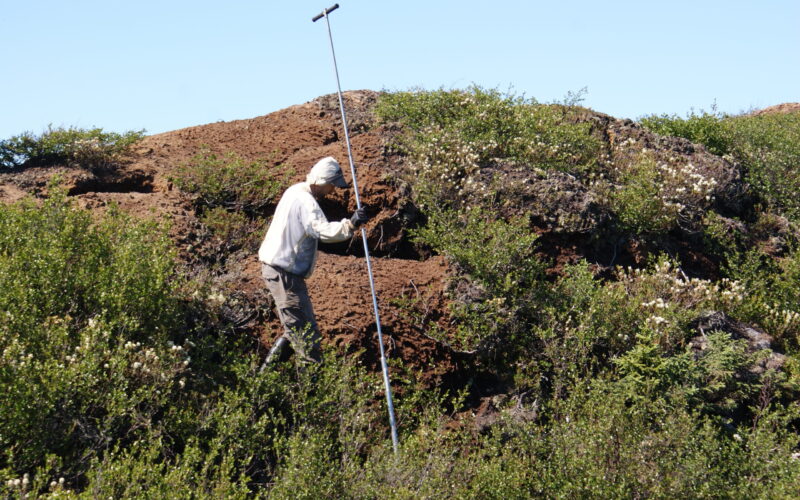


Study site: Kuujjuarapik
Person in charge: Michelle Garneau (UQAM)
Graduate students:
- Alexandre Lamarre (M. Sc., UQAM)
- Marilou Hayes (M. Sc., UQAM)
1. Development of a transfer function using thecamoebiens and reconstruction of Holocene paleoenvironmental conditions in a palsa peatland in the Kuujjuarapik area.
Ongoing climate change is having a particular impact on northern ecosystems, including peatlands in areas of continuous and discontinuous permafrost. In this context, changes in regional climatic conditions can disrupt the evolution of peat ecosystems and indirectly affect their carbon budget. As current climate change is largely attributable to atmospheric greenhouse gas (GHG) content, such as CO2 and CH4, it is important to better understand the influence of climate on permafrost peatland dynamics and carbon budget.
The main objective of this research project is to assess the effects of climate change on the evolution of peatlands in discontinuous permafrost regions by reconstructing the paleohydrology of a palsa peatland in the Kuujjuarapik area on the east coast of Hudson Bay.
Objectives:
- Develop a transfer function to infer water table elevation values for boreal and subarctic peatlands using modern thecamoebian assemblages from surface peat samples;
- Reconstructing the chronology of the various phases of peatland development by analyzing fossil thecamoebian assemblages, peat composition and carbon content of two peatland profiles.
2. Validation of the δ18O signal in the cellulose of peatland bryophytes as a paleoclimatic indicator and its application in the paleoenvironmental reconstruction of a palsa peatland.
The oxygen isotopic composition of sphagnum cellulose has been studied for some years in peat sediments for its paleoclimatic potential. While the link between the isotopic composition of the spring water used by the plant and that of the cellulose is well established, the origin of the water used and the effect of microtopography are less so. Moreover, the relationship between the oxygen isotopic composition of water in peatlands and climate is still uncertain. The aim of the present research is to determine the origin of the water used by bryophytes in different bogs and fens biotopes in Québec, and to attempt to understand the effect of climate (temperature and precipitation) on the oxygen isotopic composition of these bryophytes.
Objectives:
- Validate, using modern surface samples of mosses from 16 peatlands in Québec, the climatic potential of δ18O cellulose from bryophytes in peatlands;
- Performing a paleoclimatic reconstruction of the Kuujjuarapik region based on the temporal variation of the δ18O signal of bryophyte cellulose in a palsa peatland.