

Carbon dynamics in peatlands in the La Grande sector, James Bay | 2002-2005

Study sites:
- LG1
- LG2
- LG3
Person in charge: Michelle Garneau (UQAM)
In collaboration with:
- Monique Bernier (INRS-ETE)
- Tim Moore (McGill University)
- Pierre Richard (Université de Montréal)
- Nigel Roulet (McGill University)
- Taha Ouarda (INRS-ETE)
- Alain Tremblay (Hydro-Québec)
- Jennifer Milton (SMC-Québec)
Graduate students:
- Véronique Beaulieu-Audy (M. Sc., UQAM)
- Nicolas Laterreur (M. Sc., UQAM)
- Catherine Henry (M. Sc., UQAM)
- Mélissa Collins (M. Sc., UQAM)
- Anne-Marie Demers (M. Sc., UQAM)
- Nicola McEnroe (Ph. D., McGill University)
- Luc Pelletier (M. Sc., McGill University)
- Marie-Josée Racine (M. Sc., INRS-ETE)
- Jukka Turunen (postdoctoral intern, UQAM)
This multidisciplinary project integrated complementary data from remote sensing, ecology, biogeochemistry (particularly GHG exchange) and paleoecology. The project has enabled a spatiotemporal understanding and modeling (PAM) of boreal peatland dynamics from the early accumulation of botanical materials and their associated carbon budget to present-day surface processes.
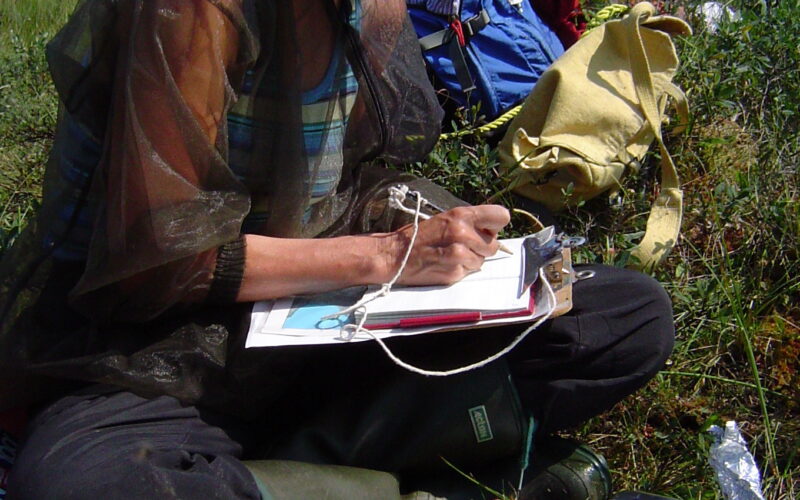
In order to characterize current GHG dynamics for each peatland, measurements of carbon dioxide (CO2) and methane (CH4) fluxes were taken at nearly 60 points distributed over the different biotopes characterizing the surface of each of the three peatlands.
The different stages of Holocene development of the LG1, LG2 and LG3 peatlands, their duration and associated carbon dynamics were reconstructed from sedimentological (loss on ignition), macrofossil, pollen and geochemical (C/N) analyses, and radiocarbon dating of core samples from each peatland.
Objectives:
- Remote sensing: Characterize and classify current regional peatland surface cover using a combination of RADARSAT and LANDSAT satellite imagery, and aerial photography;
- Surface biogeochemistry: Measure the local and regional variability of CO2 and CH4 exchanges in order to determine carbon fluxes and the relative sensitivity of boreal peatlands in relation to current climate conditions and the different global warming scenarios predicted;
- Paleoecology: Reconstruct present-day and Holocene conditions of peatland development in the La Grande watershed and associated carbon accumulation rates.